AI Is a Doggone Good Thesaurus
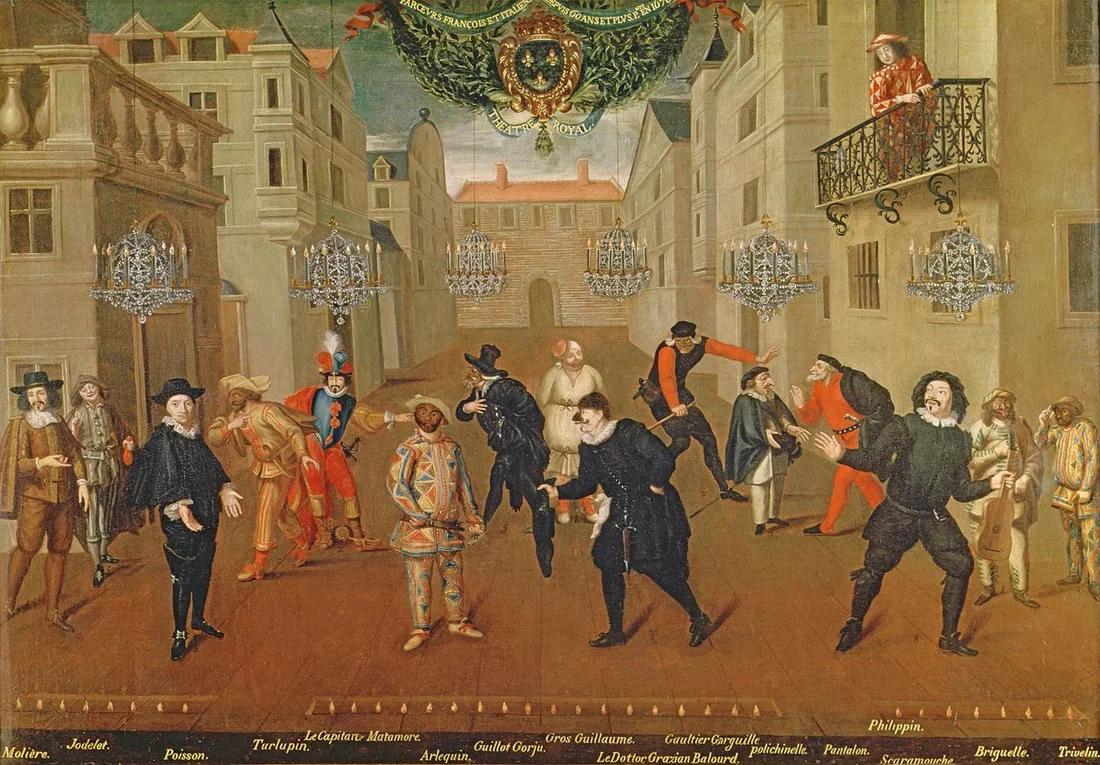
“Farceurs Français et Italiens” (which translates to “French and Italian farce actors”) by Italian painter Antonio Verrio, 1670
My favorite secret weapon as a writer is the thesaurus. I call it “secret” because any given non-writer* might call it cheating.
Consulting a thesaurus sometimes gifts you the word you’re looking for. But more often than not, it gives you a list of not-quite-right words that Venn with what you’re after, and your own magnificent human brain comes up with the actual word you need, thus giving you the satisfaction of sticking your own landing.
To reiterate the full miracle of this experience, the nuance behind why the thesaurus is such a cool tool is that it doesn’t do the work for you. But sometimes without it, you would struggle to do the work at all. It’s like the Appalachian Trail Ag nghngel of writing. Everyone loves a trail angel, you can’t convince me .
𓆝 𓆟 𓆞
Over the years I’ve found myself occasionally standing in front of high school English classes, leading writing workshops or substitute teaching. Little is more humbling. But, too, is little more inspiring than offering brain wrinkles to young minds. I very much enjoy seeing the narrowing of students’ eyes, and then perhaps one brow flick up in concession, when I make my proposition to cozy up to a thesaurus.
It’s a writerly rite of passage to come upon a word in a thesaurus that you don’t fully understand, and use it, later to find yourself in a jam. Like if you’re in a classt or a reading and botch the pronunciation. Or if you’re in a workshop and your peers are dwelling on the word you used unwisely. The hope is that you don’t crumple in embarrassment, never to write again, but that you seek to learn that word for real and redeem yourself by using it confidently and correctly down the line. Bonus points if you walk away with the notion that you should read more, because encountering words in multiple contexts is how you truly come to internalize them. And that even when you use above-board tools, you still have to own what you write.
Oh the humility! You can’t replicate these life lessons.
𓆝 𓆟 𓆞
Okay, but realistically writer’s block, or the struggle to express exactly what you want to say, doesn’t begin and end with one stuck word. It’s concepts that can be hard to pin down. The trouble with the good, old-fashioned† thesaurus is that it can’t give you multiple takes on common phrases. I can’t count how many times I’ve longed to airdrop a feeling into the thesaurus and have it still my sentiment down to a few options to jog my creativity.
AI chatbots can do that. And they do it well.
Here’s an example of what I mean. I recently inputted this prompt into a chatbot:
“I need help coming up with really condemning ways to describe people who don't know what they're doing, they're liars, they're deleting negative reviews, they're being poorly communicative, sweeping issues under the rug, etc etc...to complete this sentence: ‘She clearly has her mind made up that this organization and most involved are illegitimate __.’”
Here is a brief selection of many options it gave:
“illegitimate frauds”
“illegitimate grifters”
“illegitimate opportunists”
If you want something more literary or biting:
“a revolving door of evasive, unqualified people”
“people more concerned with optics than accountability”
“an insular culture of dishonesty and incompetence”
To which I responded, “I like ‘illegitimate grifters,’ but want to add ‘who ___,’ and go full creatively literary and descriptive in a totally non-professional way.”
I was so pleased with the results, oh my. Here are a few that had me cackling:
“illegitimate grifters who treat accountability like an inconvenience and honesty like a branding problem.”
“illegitimate grifters who light candles around the mess instead of cleaning it.”
“illegitimate grifters who speak in the soft, lacquered language of people perpetually hiding blood beneath fresh paint.”
Dang. This is my idea of a good time.
The application for this chaos? Sounding like a genius while texting my husband. I did plagiarize one of these directly, disclosing that I was using AI, inviting him to marvel at how unhinged AI was being.
On another day I asked for multiple ways of saying "I'm so grateful to be in community with you," because I was writing a stack of cards to people from my church who I’d never met—so there was only so far that writing from the heart could take me, yet I didn’t want them to all say the same thing. I read through its suggestions, and my mind was ignited enough to be able to formulate my own similar wordings without copying exactly what was suggested. Here are a few of the synonymous phrases it generated:
“I’m so thankful to share this community with you.”
“It means so much to be part of this community with you.”
“I’m so appreciative of this shared community.”
𓆝 𓆟 𓆞
If this was the only thing AI could do (okay, that and make me a timestamped schedule for the steps of baking ciabatta loaves) I wouldn’t be writing about it. I would just be using it and feeling oh so pleased. It has me nostalgic for the not-so-distant “there’s an app for that” days, when people got clever about solving their problems, and used a little technology magic to execute. Something they built. Something good ‘n’ nerdy they accomplished, versus laymen wiggling our fingertips at a gratuitously accessible tool and reaping our “reward” within moments. How forfeiting of us.
We all know by now that AI raises issues of data privacy, job loss, misinformation, environmental impacts, intellectual property infringement, ethics, and other very valid concerns. Deeply and heartily opposing each of these individual affronts to human existence while still lightly and lightheartedly engaging with AI chatbots is a dichotomy that’s difficult not only to convey, but to experience.
Socially, how does one denounce the harms of AI, while simultaneously conceding that they’re not so fringe as to denounce the technology entirely?
To concede that we’re still relevant enough to dabble with it, but not at the expense of our own original thought; not in ways that are scammy or dishonest. That to fully embrace it is incongruent with our identity, but to never have explored it at all would signal a lack of curiosity.
Curiosity.
We plug questions or prompts into AI because of our curiosity, yet the act of using it is a threat to our curiosity. That’s heavy.
𓆝 𓆟 𓆞
How does one put an end to a reflection such as this without the sensation of being flippant? Where is an eternal ellipsis when you need one? Perhaps, in lieu, I’ll end where I started before I spiraled: thesaurus evangelization. Cozy up, buds.
*To be clear, my personal definition of a writer is “someone who writes;” who literally puts a pencil to paper or documents musings in their Notes app or even who crafts an email with care. That’s pretty much everyone. But I feared I’d lose you immediately if I’d said “any given non-identifying-writer” or some other clunky phrase.
†By ”old-fashioned” I mean merely the Internet thesaurus—the kind that gives you synonyms and antonyms for the word you type in, and that’s all it does. I apologize to print-bound thesaurus loyalists. I in fact do own a physical thesaurus book, but it’s from 2007 and doesn’t contain any hypothetical new words that may have entered the common lexicon in the past couple decades! Whatever those may be!
▲▼▲
What I used AI for in this post:
I browsed through my ChatGPT history to show you some examples of when I’ve used AI as a “concept thesaurus.”
I needed help finding a real/reasonable word equivalent for “untrustworthily.” The regular thesaurus didn’t know! AI claimed it is a word—the adverb form of untrustworty—but also gave me a list of synonyms, and I chose “suspiciously.” But then I cut that part in the end anyway.
